
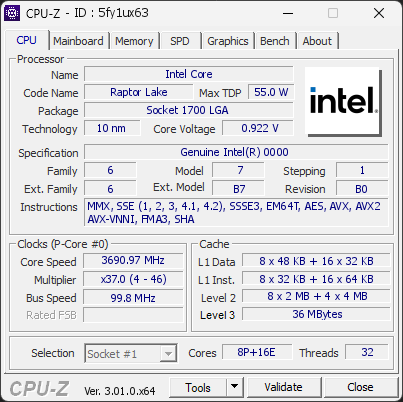
Your processor is an Engineering sample. An Engineering Sample (ES) CPU is a pre-release processor sent by the manufacturer to OEMs/engineers for testing and validation.
It often has unfinished microcode/firmware, may run at non-final clocks/voltages, and can show bugs or different performance vs retail chips.
ES chips are usually not for sale, may be locked/traceable, and don’t always support full warranty/official support.
Your CPU is running at a high temperature (100°C). At this level, the processor may slow itself down to avoid overheating.
This usually means the cooling system is struggling to keep the CPU at a safe temperature. It can happen if the cooler is clogged with dust, not working correctly, or simply not powerful enough for this type of processor.
We recommend checking that the fan spins normally and that the cooling system is properly installed. Cleaning the cooler or improving airflow can help bring the temperature back to a safer range.
Your processor reached 100°C during the test, hotter than 100 % of the 101 validations recorded with the same Intel Core. The typical maximum for this model is 66°C.
The same CPU under the same load usually lands close to the typical value. A large gap points at the cooling rather than the processor: a cooler too small for this CPU, a poor mount or dried thermal paste, dust, low airflow in the case, or a BIOS power limit set higher than stock.
Compare your cooling setup with what this processor needs, check the cooler mounting and the thermal paste, clean the fans and filters, and review the case airflow. The CPU is not at risk yet, but it is running hotter than it should.
Your processor runs microcode revision 0x104, older than the 0x12B revision that fixes a known stability and degradation issue on this CPU family.
Intel 13th and 14th generation Core processors could receive excessive voltage from the BIOS, which causes crashes and permanent damage over time. The fix is delivered through a microcode update included in newer BIOS versions.
Update the motherboard BIOS to the latest version from the manufacturer, then check that the microcode revision has changed. Until then, keep the BIOS power and voltage settings at their defaults (Intel Default Settings).

Scan this QR code
To open this page on your phone
Previous validations from this PC
Unexpected crashes (BSOD)
No unexpected crashes (BSOD) recorded on this PC.
Boot Time details
Hardware errors (WHEA)
1 error recorded in the Windows event log.
Driver problems
No driver problems detected.
Flagged processes
88 running processes, none flagged.
Inform a support service
If a partner support service is helping you with this PC, enter the service code they gave you to send them this validation. A valid service code is required.