
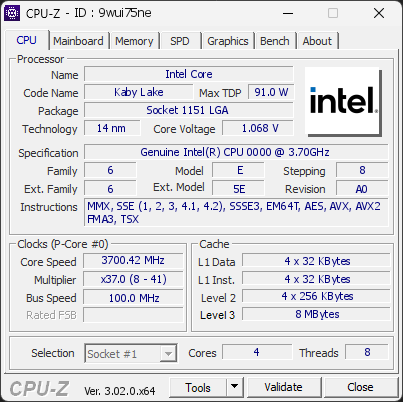
Your processor's power limits (PL1/PL2) appear to be set to an unlimited value. This means the CPU is allowed to draw as much power as it wants, with no enforced safeguard beyond what the cooling and voltage regulation can sustain. While this can unlock maximum performance, the processor may run hotter, consume more energy, and experience increased electrical stress over time.
This configuration is often applied automatically by motherboard manufacturers through performance-enhancing profiles. Even without any user changes, many boards ship with these limits effectively disabled by default.
We recommend reviewing your power limit settings in the BIOS or in the software provided by your motherboard. Restoring sensible PL1/PL2 values (typically aligned with the processor's rated TDP) can help lower temperatures, reduce power consumption, and extend the long-term reliability of your CPU.
Your processor is an Engineering sample. An Engineering Sample (ES) CPU is a pre-release processor sent by the manufacturer to OEMs/engineers for testing and validation.
It often has unfinished microcode/firmware, may run at non-final clocks/voltages, and can show bugs or different performance vs retail chips.
ES chips are usually not for sale, may be locked/traceable, and don’t always support full warranty/official support.
1 device(s) have no driver installed, so Windows cannot use them at all. This is very common on a fresh Windows installation, where the chipset drivers have not been installed yet.
Windows ships generic drivers for common hardware but not for chipset controllers, card readers, or manufacturer-specific devices, which have to be installed separately.
Install the chipset driver package for your motherboard or laptop from the manufacturer's support page, then run Windows Update. The Drivers button in the Software section lists every device still waiting for a driver.
No graphics driver is installed for your graphics card. Windows is currently running on its generic display driver.
Without the manufacturer's driver, 3D acceleration is unavailable: games and GPU-accelerated applications cannot start, video playback is degraded, and the display may be limited to a low resolution.
Download and install the latest driver from your GPU manufacturer's website (NVIDIA, AMD or Intel) to restore normal operation and full performance.
The partition C: (on disk HP SSD EX900 120GB) is almost full, with only 23.4 GB of free space remaining. With so little room, Windows may struggle to stay stable or apply future updates.
You can free space using the built-in Windows cleanup tool or by removing applications and files you no longer need.
The drive HP SSD S750 512GB has reported 2 media error(s).
Media errors indicate that the drive was unable to read from or write to the NAND media successfully. A small number of media errors may be recoverable, but any increase can indicate failing flash cells, controller issues, or progressive drive degradation.
Back up any important data on this drive immediately, monitor the error count for further increases, and consider replacing the drive if the count continues to rise or reaches a critical level.
This PC encountered 2 unexpected crash(es) (BSOD, blue screen) in the 30 days before this validation, the most recent on 2026-10-15.
Crashes like these are often caused by a faulty driver, unstable overclocking or memory settings, overheating, or failing hardware.
Make sure Windows and your drivers are up to date. If the PC is overclocked, try returning to stock settings. The BSOD Details button in the Software section lists each crash.

Scan this QR code
To open this page on your phone
CPU clocks
Last sample and peak over the test, values in MHz
| Clock | Current | Peak |
|---|---|---|
| Cores | ||
| #0 | 3700.42 | 4080.46 |
| #1 | 3700.42 | 3871.20 |
| #2 | 3700.42 | 3975.83 |
| #3 | 3700.42 | 3975.83 |
| Uncore / BCLK | ||
| Ring / LLC | 3500.40 | 3871.20 |
| CPU BCLK | 100.01 | 104.63 |
Previous validations from this PC
Unexpected crashes (BSOD) (5)
Boot Time details
Hardware errors (WHEA)
No hardware errors recorded in the Windows event log.
Driver problems
1 device needs attention, 1 more ignored.
Flagged processes
47 running processes, none flagged.
Inform a support service
If a partner support service is helping you with this PC, enter the service code they gave you to send them this validation. A valid service code is required.