
Introducing CPU-Z Validator V3
CPU-Z Validator is an online tool that validates, analyzes, and lets you share your PC’s hardware configuration and performance. It also helps detect potential hardware, software and configuration issues through system health checks and diagnostics.
After several months of discussions and valuable feedback from the community, it’s now time to unveil CPU-Z V3 and the new Validator V3!
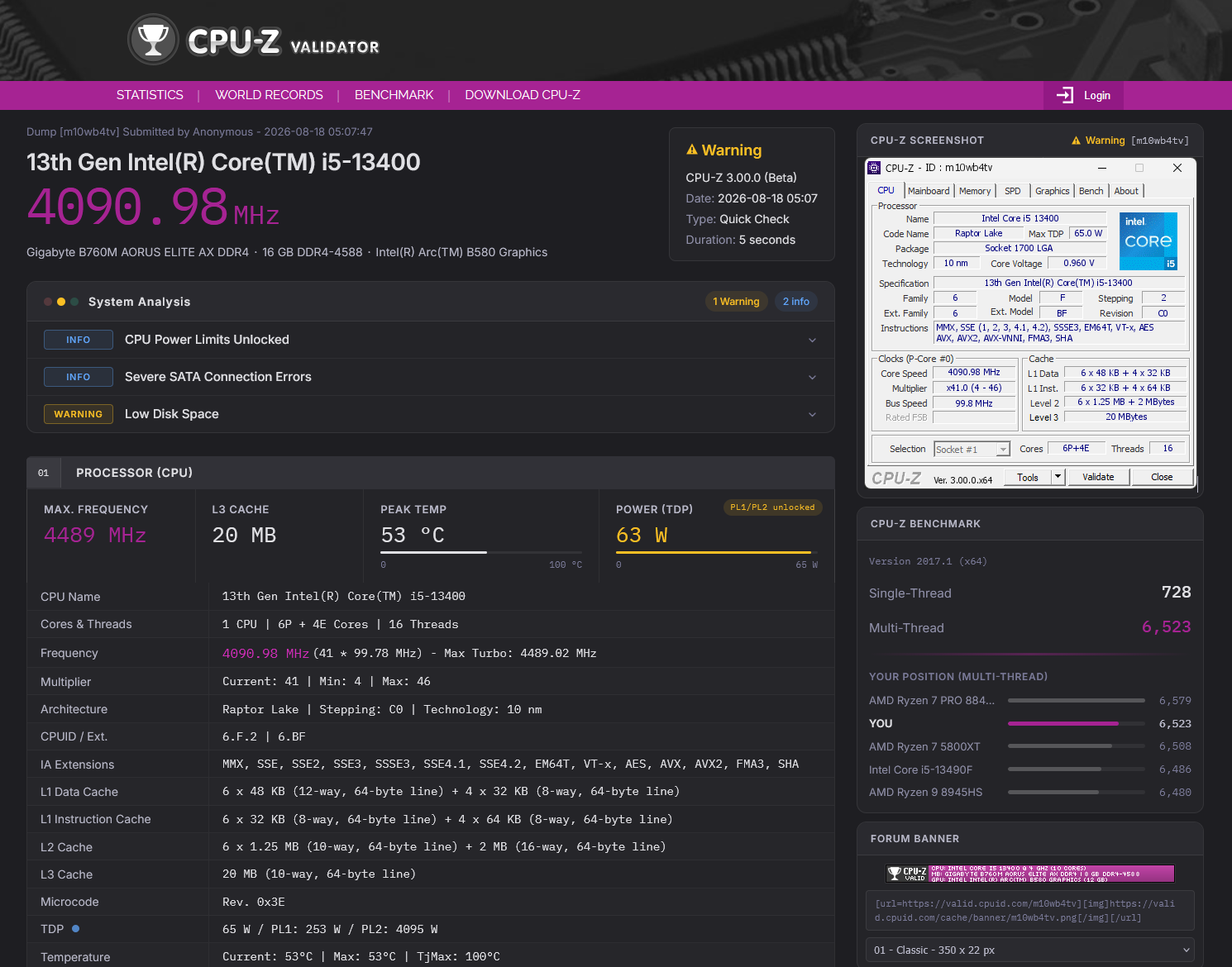
With CPU-Z Validator V3, our goal is to preserve the overclocking DNA of CPU-Z while expanding its usefulness to a wider audience. Power users and overclockers will still be able to validate and share results of perfectly optimized systems, while less experienced users will gain a clearer understanding of their system and any potential issues.
In addition to the current validation features, V3 will gradually introduce several modular features, starting with a new statistics page and a component analysis feature designed to help users understanding what could be wrong with their PC. The goal is to provide a simple and accessible way to highlight potential issues, inconsistencies, or suspicious configurations based on the detected hardware and software.
We will detail all the available modes here:
Standard Validation
Available nowThe standard validation is available from the “Validate” button, exactly as before. A name and email address are optional and are only required to create an account and manage your validations. In less than 10 seconds, a CPU-Z Validation V3 page will be displayed, showing the current health of your computer.
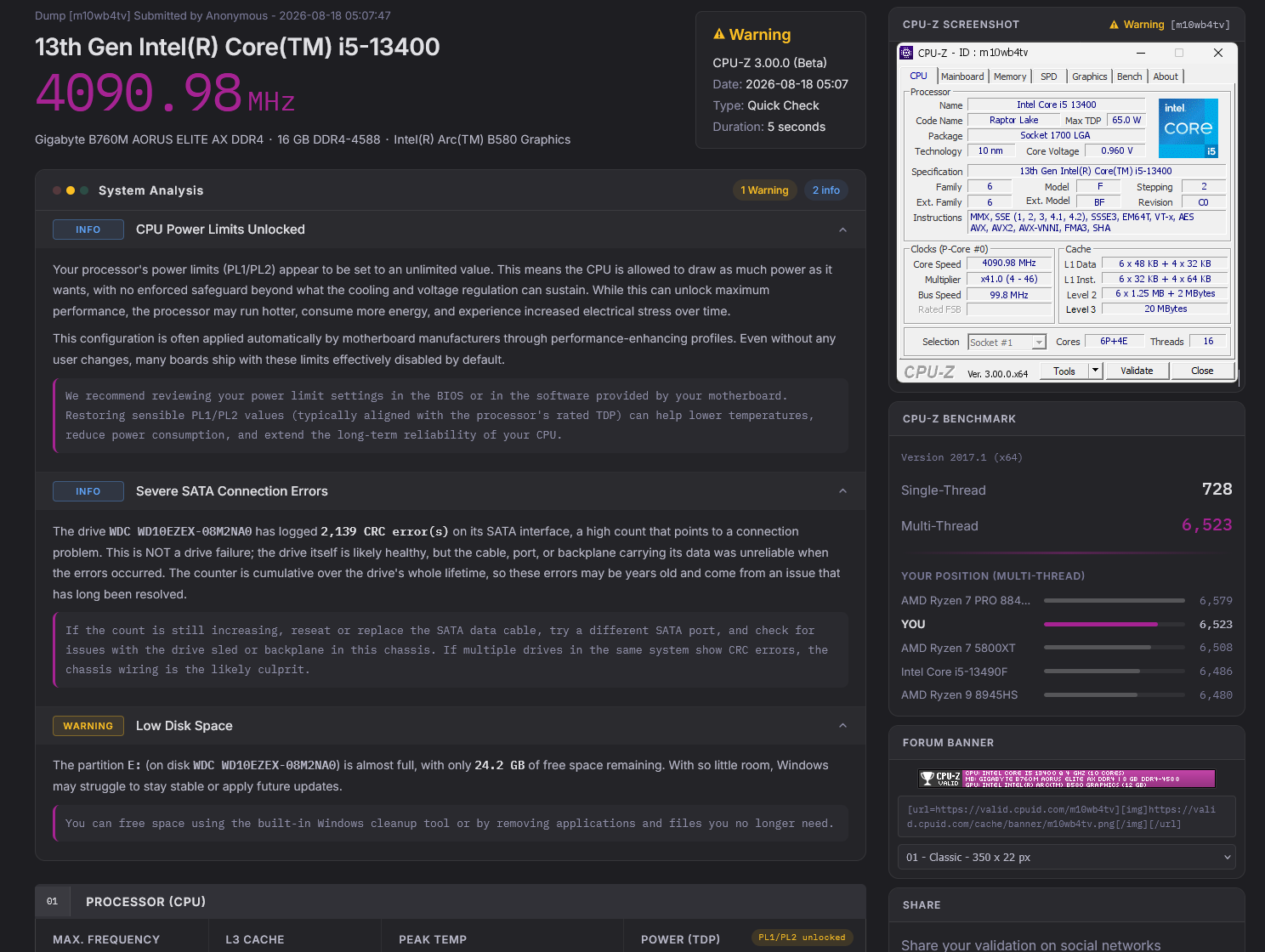
We worked for more than a year with several major support services and repair stores to add meaningful system analysis messages. They’re classified according to the usual Critical / Warning / Informational levels.
We cover more than 100 detection points, including, for example, outdated drivers, an overheating CPU or SSD, bloatware, various hardware issues, and much more.
Various tools are available to easily share the validation. Good ol’ screenshots and forum banners are still available.
Advanced Validation
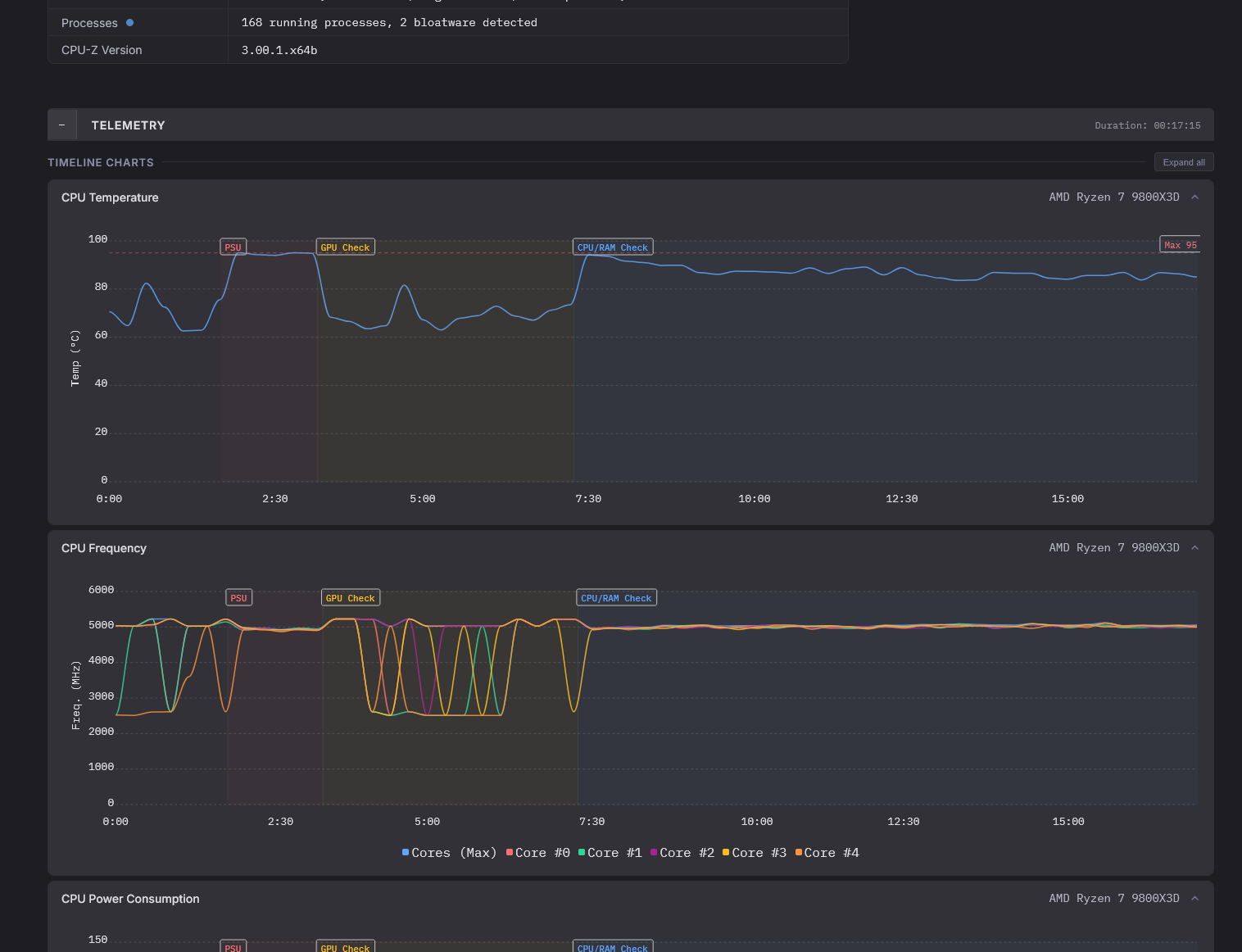
Coming Soon!The advanced validation is as simple as the standard validation for the user, but it requires much more time to complete, ranging from a couple of minutes to several hours. Advanced Validation is an in-depth diagnostic tool designed to identify hardware issues and check the health of your computer under heavy load. It includes much more complex workloads, along with error-detection engines targeting the CPU, RAM, and GPU.
Advanced Validation also includes a significantly extended benchmarking tool that not only covers CPU performance, as before, but also GPU, RAM, and storage performance. Enhanced sensor monitoring, based on HWMonitor, has also been added to display various live temperatures, frequencies, fan speeds, and more on the validation page.
The Advanced Validation engine has been developed entirely in-house using low-level code to remain lightweight yet powerful. This engine is already being used in production in repair stores and RMA centers, with tens of thousands of computers already tested. A sample report is available here.
XOC Validation
Available nowThe core feature of CPU-Z for overclocking is the validation of frequencies. 10+ years ago, measuring CPU frequency was quite simple. You just had to check the number of elapsed cycles vs a known timer, read the CPU registers for the current multiplier and you’re done.
Today, the situation is MUCH more complex. Any part of the CPU can potentially run at different, desynchronized frequencies. The base (input) clock is altered by numerous internal PLLs controlled by embedded power-management MCUs, which may boost or throttle frequencies, use ratios, “gears,” or various other obscure parameters, changing the final frequencies several times per second and at different rates. Tracking everything simultaneously has become extremely difficult.
In addition, memory overclocking has become increasingly important, and the current validation system was not originally designed to handle it properly. As a result, many overclocking attempts are rejected, and the reason is not always clearly explained. This is why we need a new approach.
With CPU-Z Validator V2, the only way to obtain a “validated” status is to use Standard Mode (5-sec load, one-shot measurement, all frequency data sources within 1%). Any drift in one parameter means the dump is rejected. The XOC Mode in V2 removes all load and most internal checks, which leads to the final “unsure” status.
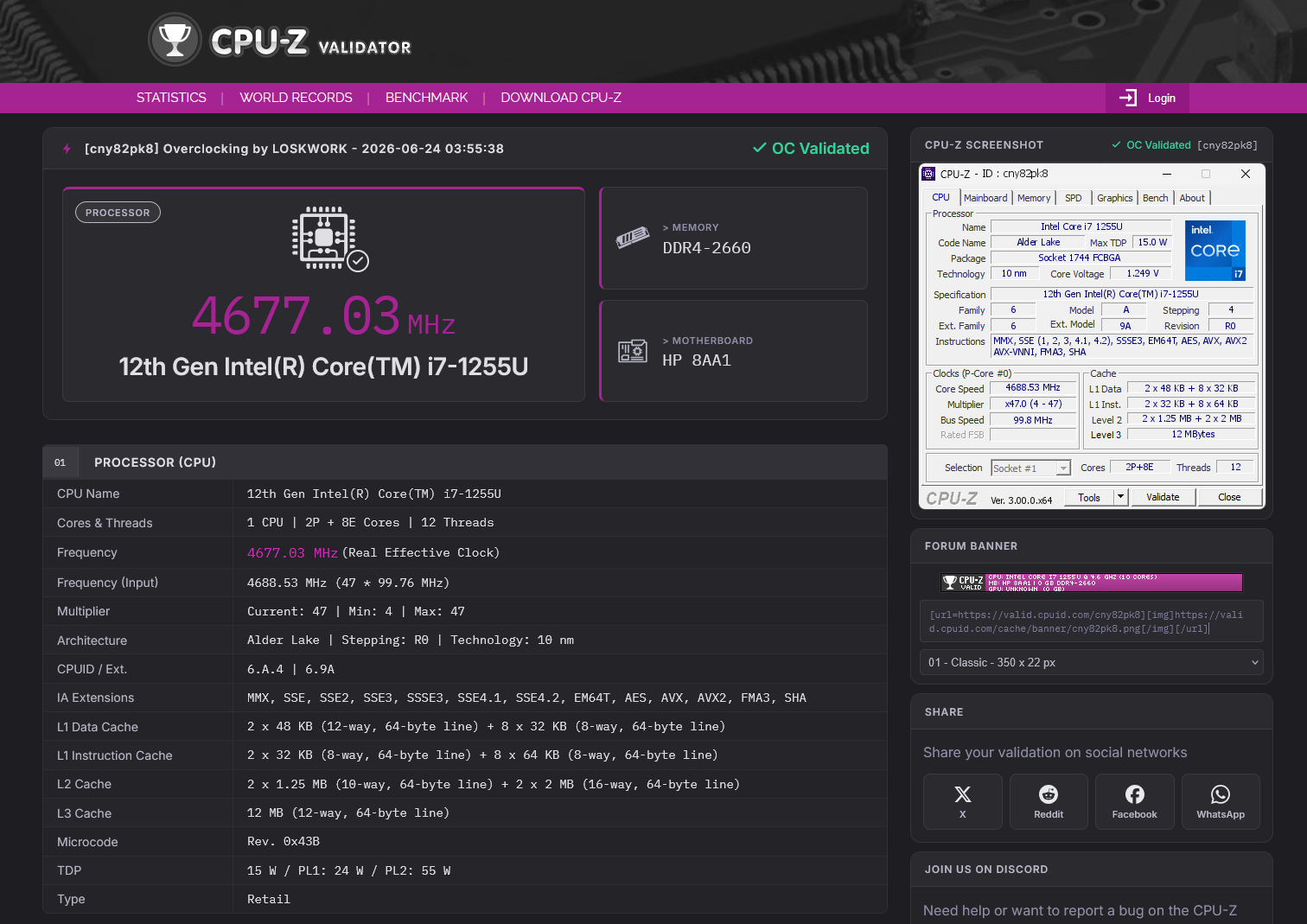
On V3 XOC Mode, we will keep the load disabled, but this time we will calculate both the “effective” frequency (lowest top frequency reached across all data sources) and the “input” frequency. If the effective frequency is lower than the input frequency, the dump will still be validated but the real, effective frequency will be used as the final validated frequency.
- V2 Standard
- 5-sec load, one-shot measurement, all sources within 1%: any drift rejects the dump.
- V2 XOC
- No load, most internal checks removed: ends as “unsure”.
- V3 XOC
- No load, effective vs input frequency: still validated, at the real effective frequency.
Additional details about V3
- The Validation V3 code is evolving daily. Please report bugs or any wanted features to our Discord forum (see below)!
- The CPU-Z validator will change its main URL from valid.x86.fr to valid.cpuid.com. All previous links will remain working.
- CPU-Z 3.xx requires at least a patched Windows 7. The toolchain we use must be upgraded to support new features and it’s now impossible to get a signed driver working for older OS.
- CPU-Z 3.xx will be available as 32 and 64 bit builds as previously.
- Many features will be enabled as soon as we have enough validations on the V3 database to process statistics efficiently.
- We will do our best to update CPU-Z Vintage (32 bit) to cover Windows 9x to Windows Vista, but it’s quite a challenge. Toolchain for these old OS are extremely old and not supported for decades.
- A small CPUID Discord server has been launched. We don’t have much experience with Discord, but we’ll do our best to check it regularly. Do not hesitate to report bugs or misdetection, we’re here to help.
- Offline validations are still possible.
- Validation V2 (V2.15+) will still accept validations for 60 days after this release, then the V2 database will be switched to read only. Dead line for V2 is October, 20th.
Need help, spotted a misdetection or want to report a bug on the CPU-Z Validator V3?
You can reach us on our Discord server.